Moria
For every one of the 31,102 verses, Moria has already worked out which other texts are related to it, by five methods that do not depend on one another — and it shows you, verse by verse, what each link is actually made of.
A note on language. Opened from these pages Moria speaks the language of the page — English here, Dutch or Spanish there — and starts in a reading text to match. Switching that text changes what you read, never a score. Of the five methods, three never touch a translation: similarity in the original works on the Hebrew and Greek lemmas, the quotation bridge on the Greek of the Septuagint, and the cross-references are reader-weighted judgements from a dataset. Two do: quotations are found in the Statenvertaling, thematic kinship in the Statenvertaling and the King James Version together, and the wording of those translations shapes what they find. Every link says which method found it.
What is in it
The text, in five translations and two original languages. Five translations: the Statenvertaling in the extended edition, which carries a Strong’s number on every Dutch word and the original marginal notes, and beside it the King James Version, the Berean Standard Bible, the Reina-Valera 1909 and the Versión Biblia Libre. Two original languages: the Hebrew of the Westminster Leningrad Codex and the Greek of MorphGNT/SBLGNT. Those two are parsed word by word — 444,000 words, each with its root form, its part of speech and its inflection.
The Septuagint, aligned. Swete’s edition of the Greek Old Testament, set against the ordinary verse numbering — and openable as one of the reading texts, beside the King James and the rest. Which Greek verse belongs to which ordinary verse is not a hand-written table: it is worked out from the text itself. Proper names stay recognisable through a translation — Ἰσραήλ next to Yisraél — and together with the length of each verse that is enough to compute, book by book, which verse answers to which, without the run ever going backwards. On 34 known checkpoints it comes out right 33 times.
A map, the gospels side by side, and a concordance. The map puts the biblical places on their coordinates from Tyndale House’s TIPNR, over a simplified Natural Earth coastline. The four gospels stand side by side, each verse against the verse that comes closest to it in the other three. And the parsing is searchable, so that all imperatives of שׁמע is a one-line query rather than an afternoon’s work.
A dossier you own. Verses collected while reading, each with a note, saved as a small JSON file next to your work — deliberately a file and not browser storage, so nothing disappears when a browser tidies up. It exports to Word and Markdown.
The five methods, and what each one can and cannot show
Most study Bibles hand you a column of cross-references and no account of where they came from. Moria does the opposite: it records five kinds of link for every verse and shows, for each, what that link rests on. The five are deliberately different from one another: where several of them fall on the same pair of texts independently, that agreement means something. Where only one does, the kind of evidence matters, and it is named.
| Method | What it rests on | What it finds |
|---|---|---|
| Cross-references | The openbible.info dataset (CC-BY): about 700,000 references from one verse to another, with vote scores, drawn largely from the Treasury of Scripture Knowledge. A tradition of interpretation, not a measurement of the text — and the only method that shows no word-level evidence, because there is none to show. | The classical references, weighted by how many readers have affirmed them. |
| Original-language overlap | Lemmas and Strong's numbers from the Westminster Leningrad Codex and MorphGNT/SBLGNT; tf-idf over single words and word pairs. Cannot reach between Hebrew and Greek; that is what the Septuagint bridge is for. | Parallel passages and verbatim borrowing inside one language — 2 Kings 18 against Isaiah 36. |
| Quotation via the Septuagint | Every New Testament verse compared against the Greek Old Testament (Swete) on word forms, word pairs and rare word chains. Silent where the New Testament follows a different Greek text, or the Hebrew. | Old Testament quotations in the New at the level of the original — with no translation in between. |
| Quotation via the translation | Rare four-word content phrases shared between verses, weighted by how rare they are. Runs through a translation, so its wording partly decides what turns up. | Quotations and allusions across the canon, including where the Greek diverges. |
| Thematic kinship | Latent semantic analysis in 300 dimensions over two translations at once, mixed with direct word overlap. Statistical, not exegetical. Judge every result yourself. | Texts about the same thing that do not share the same words. |
The point of separating them is that they fail differently. A statistical method drifts toward vocabulary; a traditional reference list carries the assumptions of its compilers; a quotation search finds only what was quoted. Read together, and with their evidence visible, they let you see which kind of claim you are looking at. How each method works in detail →
What makes it different
Every link comes with its evidence, recomputed live between the two verses using exactly the same word segmentation and stop-word lists as the analysis itself — otherwise the highlighting would show something other than what caused the score.
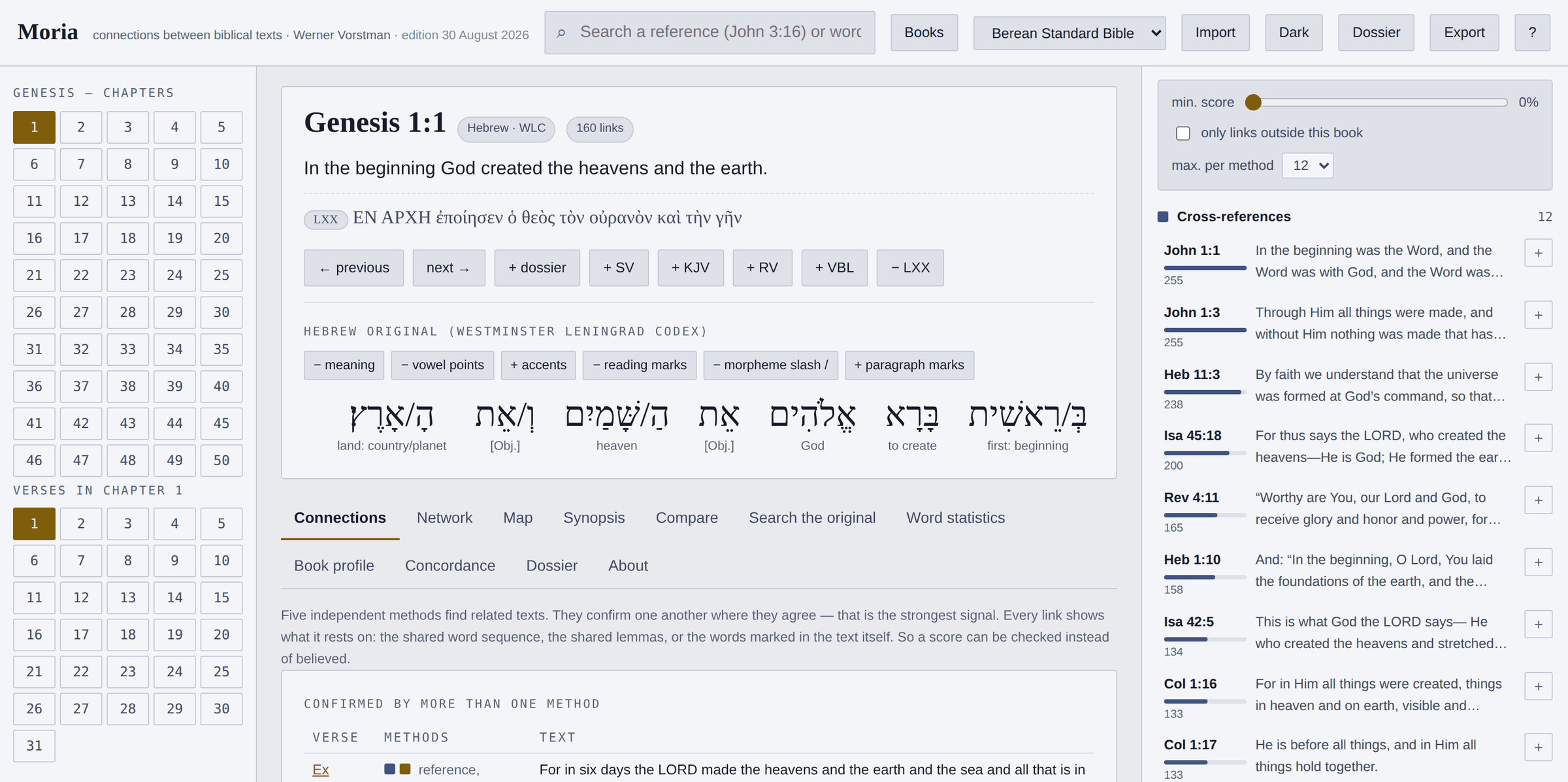
For a quotation through the Septuagint, that evidence is the shared Greek chain: at Psalm 110:1 and Hebrews 1:13, Κάθου … δεξιῶν … ἕως … ἐχθρούς … ὑποπόδιον … ποδῶν. For original-language overlap it is the root forms the two verses share, ordered by rarity so the distinguishing word comes first and not the article. For thematic kinship it is the shared content words, marked in the text.
And for the classical cross-references there is nothing — which is the point. Those are judgements handed down by readers, not measurements of the text. They are not worth less for that, but they rest on something different, and that difference ought to be visible.
Why it is built this way
One file, no server. Moria has no back end, no account, no analytics and no network calls. Everything is inside the file. That is partly a matter of privacy — nobody can see what you look up, because there is nowhere for that to go — and partly durability. A study tool that depends on a server is a study tool with an expiry date. Save the file and it will still open in ten years.
Evidence over authority. Any system can produce a list of related verses. The question that matters is what the list is made of. So each connection shows its own working, and the one method with nothing to show — the inherited cross-references — says so plainly rather than borrowing credibility from the four that do.
Its limits, in writing. Every method here has a blind spot, and each is stated on the method page next to the thing it does well. A tool that only advertises what it can do teaches you to trust it too much.
What the search bar at the top can do
The bar at the top does two different things, and which one depends on what you type.
Type a reference — Joh 3:16, gen 1, Psalm 23 — and it goes straight there. Abbreviations are fine, case does not matter, and a chapter without a verse number opens at verse 1.
Type anything else and it is a search, with the answer written into the right-hand column in place of the list of links. At the top of that column is the number of verses found and a button back. This works for a word from the translation you are reading (shepherd), for a Greek word (ἀγάπη), and for a Strong’s number (H7225, G26).
One thing the bar cannot do is a Hebrew word. On the Hebrew side it searches a list that holds Strong’s numbers rather than Hebrew words, so ראשית will always come back empty. For Hebrew there is the number — H7225 does work — or the Search the original tab, which does search the words themselves and can filter them by their grammar as well.
On a narrow screen that right-hand column sits below the text rather than beside it. The page then brings the results into view itself, so that you are not typing into nothing.
Every book on one screen
Beside the search field is a Books button. It puts all sixty-six books on the screen at once, in canonical order, with the Old and the New Testament coloured apart. Choose a book, then a chapter, then a verse: three taps from anywhere to anywhere, without typing. The shortcut is b, and Esc closes it again.
That is the third way to a verse, beside the search field — which takes a reference as readily as loose words — and the side column, where the arrow keys carry you on verse by verse.
How to use it
Start with a verse you already know well. Look at what the five methods return for it and, more usefully, at where they disagree. Agreement between independent methods is the strongest signal in the whole system; a link found by one method alone is a question, not an answer.
When something is worth keeping, put it in the dossier with a note, and save that dossier as a file next to whatever you are writing.
Why the analysis is called Moria
Moriah is where Abraham was sent to look, and where he found that what he had been told and what he was shown were not the same thing until he went and saw. The name is a reminder that the work of study is the going and the seeing. It belongs to the analysis, not to this site.